Top Automotive Companies in India - India's Leading Automotive Innovators and Manufacturers

Table of Contents
India’s automotive industry is one of the largest in the world. It includes two-wheelers, cars, trucks, EVs and three-wheelers. Whether in the market for a budget hatchback, a rugged SUV or a large bus, Indian automakers have covered all. Further, they keep increasing the production of electric scooters. Top automotive companies in India are Tata Motors, Maruti Suzuki, Mahindra, Kia, and Hyundai. Due to these companies, India has become a key spot for car manufacturing and the growing EV market.
Which Are the Most Preferred Automotive Companies in India?
The chart below reflects ViewGates proprietary brand popularity ranking methodology, based on a combination of internal analysis, survey insights, consumer preference signals, search trends, digital visibility, publicly accessible industry data, and other comparative indicators. Rankings are independently evaluated and updated by the ViewGates Editorial & Research Team to deliver credible, research-backed insights.
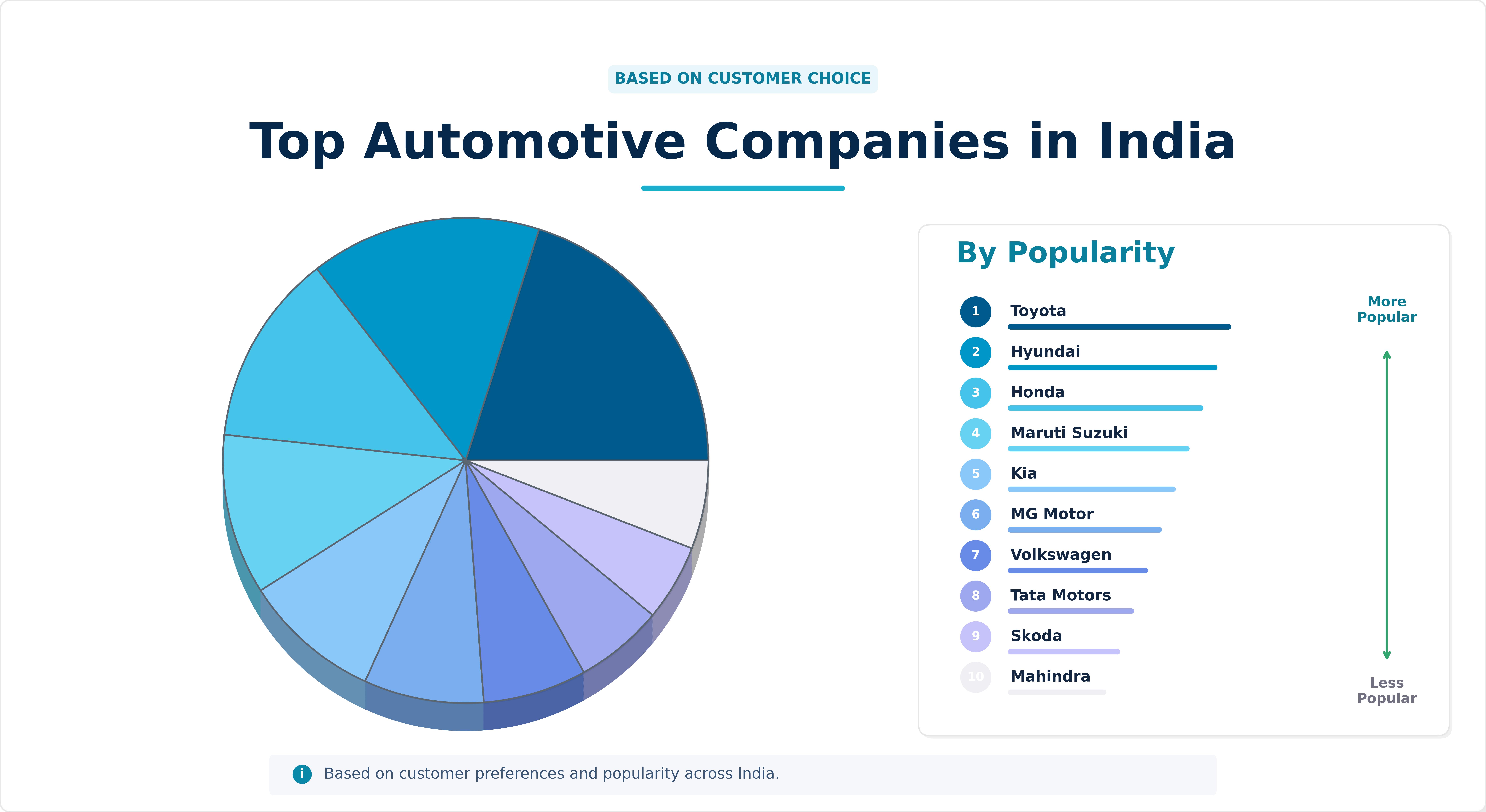
Comparing the Top 10 Automotive Brands in India
These ratings reflect ViewGates independent expert evaluation across weighted factors (service quality, support, market presence). They are not user-submitted scores:
| Brands | Best For | Pricing | ViewGate Score | Sub-scores (Quality · Support · Presence) |
| Toyota | Reliable family and fleet vehicles | Premium | 4.78 / 5 | 4.9 · 4.7 · 4.7 |
| Hyundai | Value-conscious urban car buyers | Mid-range | 4.65 / 5 | 4.7 · 4.6 · 4.6 |
| Honda | Fuel-efficient sedans and hatchbacks | Mid-range | 4.60 / 5 | 4.6 · 4.5 · 4.6 |
| Maruti Suzuki | Affordable daily-use vehicles | Budget | 4.55 / 5 | 4.5 · 4.5 · 4.6 |
| Kia | Stylish urban SUVs and sedans | Mid-range | 4.50 / 5 | 4.6 · 4.4 · 4.5 |
| MG Motor | Modern connected SUVs | Mid-range | 4.40 / 5 | 4.5 · 4.3 · 4.4 |
| Volkswagen | Premium German engineering cars | Premium | 4.35 / 5 | 4.6 · 4.2 · 4.3 |
| Tata Motors | Robust commercial and passenger cars | Budget | 4.20 / 5 | 4.3 · 4.1 · 4.2 |
| Skoda | European-style sedans and SUVs | Mid-range | 4.10 / 5 | 4.2 · 4.0 · 4.1 |
| Mahindra | Utility vehicles and commercial use | Budget | 4.05 / 5 | 4.1 · 4.0 · 4.1 |
Detailed Profile of the Top Automotive Companies in India
Here is the overview of the top automotive companies in India:
1. Maruti Suzuki
| Company Name | Maruti Suzuki |
|---|---|
| Established Year | 1981 |
| Headquarters | New Delhi, India |
| Official Website | Click Here |
Maruti Suzuki India Limited is an automobile manufacturer primarily engaged in the production and sale of passenger vehicles. Its portfolio includes hatchbacks, sedans, SUVs, and vans catering to private and fleet customers. The company holds a substantial market share in India, supported by extensive sales and service networks.
2. Hyundai
| Company Name | Hyundai |
|---|---|
| Established Year | 1996 |
| Headquarters | Gurugram, India |
| Official Website | Click Here |
Hyundai Motor India Limited designs, manufactures, and sells passenger vehicles including sedans, SUVs, and electric vehicles. It maintains a significant presence in India’s automotive market and focuses on innovation, product quality, and after-sales services. Hyundai’s strengths include diversified product offerings, modern technology adoption, and strong dealer networks.
3. Tata Motors
| Company Name | Tata Motors |
|---|---|
| Established Year | 1945 |
| Headquarters | Mumbai, India |
| Official Website | Click Here |
Tata Motors Limited manufactures and sells a range of vehicles including passenger cars, commercial vehicles, and electric mobility solutions. The company is active in India and several international markets, serving private individuals, commercial operators, and government organizations.
4. Mahindra
| Company Name | Mahindra & Mahindra Limited |
|---|---|
| Established Year | 1945 |
| Headquarters | Mumbai, India |
| Official Website | Click Here |
Mahindra & Mahindra Limited produces utility vehicles, SUVs, commercial vehicles, and electric vehicles. It has a notable presence in rural and urban markets, and serves individual buyers, fleet operators, and agricultural sectors. The company’s strengths lie in off-road vehicle expertise, diversified products, and strong regional networks.
5. Kia
| Company Name | Kia India Private Limited |
|---|---|
| Established Year | 1992 |
| Headquarters | Anantapur, India |
| Official Website | Click Here |
Kia India Private Limited focuses on the production and sales of passenger vehicles, including compact cars, sedans, and SUVs. It has established a growing presence in India with a focus on design, technology, and customer experience. Typical customers are urban private buyers and fleet operators.
6. Toyota
| Company Name | Toyota Kirloskar Motor Private Limited |
|---|---|
| Established Year | 1937 (Toyota Motor Corporation), India subsidiary 1997 |
| Headquarters | Bengaluru, India |
| Official Website | Click Here |
Toyota Kirloskar Motor Private Limited manufactures and sells passenger cars, SUVs, and hybrid vehicles in India. It serves individual buyers, fleet operators, and corporate clients. The company is recognized for technology integration, hybrid and electric vehicle development, and reliable service networks.
7. Honda
| Company Name | Honda Cars India Limited |
|---|---|
| Established Year | 1948 (Honda Motor Co.), India subsidiary 1995 |
| Headquarters | Greater Noida, India |
| Official Website | Click Here |
Honda Cars India Limited produces sedans, hatchbacks, and SUVs for private and fleet customers. The company emphasizes fuel efficiency, safety features, and technological enhancements. Its strengths include brand recognition, vehicle reliability, and dealer network coverage.
8. MG Motor
| Company Name | MG Motor India |
|---|---|
| Established Year | 1924 (MG Motor UK), India subsidiary 2017 |
| Headquarters | Gurugram, India |
| Official Website | Click Here |
MG Motor India manufactures and sells SUVs and electric vehicles targeting urban private buyers. The company focuses on connected car technology, safety features, and customer engagement. Typical customers include individuals seeking premium and technology-oriented vehicles.
9. Skoda
| Company Name | Skoda Auto India |
|---|---|
| Established Year | 1895 (Škoda Auto), India subsidiary 2001 |
| Headquarters | Pune, India |
| Official Website | Click Here |
Skoda Auto India produces passenger vehicles and SUVs, serving individual buyers and corporate fleets. The company emphasizes design, engineering, and reliability. Key strengths include European engineering standards and dealer support networks.
10. Volkswagen
| Company Name | Volkswagen India |
|---|---|
| Established Year | 1937 (Volkswagen AG), India subsidiary 2007 |
| Headquarters | Pune, India |
| Official Website | Click Here |
Volkswagen India manufactures passenger cars, SUVs, and electric vehicles. It serves private buyers and corporate clients, focusing on engineering quality, safety, and technology adoption. Strengths include international brand experience and global supply chain capabilities.
Key Evaluation We Assess
This table shows few major evaluation factors that are used to evaluate automotive companies:
|
Evaluation Factor |
What We Assess |
|
Product Quality & Manufacturing Excellence |
Vehicle build quality, reliability, production consistency, and process efficiency. |
|
Technical Expertise & Regulatory Compliance |
Engineering capabilities, R&D innovation, safety standards, certifications, and regulatory adherence. |
|
Service Network & After-Sales Support |
Dealer network reach, responsiveness to service requests, warranty fulfilment, and parts availability. |
|
Cost Competitiveness & Ownership Value |
Pricing relative to features, total cost of ownership, financing options, and long-term value. |
Why Selecting the Right Automotive Brand is Essential for Comfort and Safety
The selection of automotive company directly impacts your daily comfort, long-term safety, and peace of mind on the road. Tata Motors introduced the Tata Nexon that is first car in India to receive a 5-star Global NCAP safety rating. It proved that brands invest in crash protection, airbags, and strong body structure to save lives. While, vehicles from local and less trustworthy brands with poor safety standards can give put the passengers at serious risk. Whether it's Maruti Suzuki's fuel efficiency for daily commuters or Mahindra's tough build for rough terrains, choosing the right automotive brand ensures you and your family feel safe while travelling.
How to Choose the Right Automotive Company
The following points to notice while choosing the right automotive company:
- Assess Product Quality and Reliability – Review build quality, safety ratings, and long-term performance of vehicles.
- Evaluate Technical Expertise – Consider the company’s R&D capabilities, innovation track record, and adherence to safety and regulatory standards.
- Examine Service and Support Network – Check availability of dealerships, service centres, spare parts, and after-sales support.
- Compare Cost and Ownership Value – Analyse pricing, financing options, fuel efficiency, maintenance costs, and total cost of ownership.
- Review Customer Feedback and Reputation – Look at reviews, brand perception, and reliability reports from other buyers.
Automotive Companies Trends in India: What You Should Know
The following trends are seen in India automotive companies:
Material Trends: Tata Motors has been incorporating enhanced battery management systems and localized lithium-ion battery packs, which reflects a clear industry shift from traditional steel-heavy ICE vehicle parts to lightweight materials and locally manufactured EV components. Ashok Leyland initiated construction of a new battery to localize critical EV components and reduce import dependency,
Pattern in Demand: The demand for SUVs (sport utility vehicles) keeps increasing over the years, with EV demand showing improving stability, hybrids normalizing, and petrol continuing to dominate volume segments. The EV adoption in India has increased in recent years.
Automotive Price Range: Vehicle premiumization has made the price of vehicles costly, where consumers increasingly demand advanced features and connectivity, pushing average vehicle prices upward across segments. At the same time, the cost of batteries is falling gradually making entry-level EVs more affordable for middle-class buyers in both urban and semi-urban areas.
Types of Vehicles: Various types of vehicles exist in the automotive market of India, such as two-wheelers, passenger cars, SUVs, electric vehicles, commercial trucks, buses, and three-wheelers. New models have presented in India, like Sierra EV SUV, Volvo presented the EX90 SUV, and VinFast launched two new MPV models.
Sustainability Trends: Indian automotive manufacturers are moving towards the green vehicle technology to reduce their environmental impact. They have started using electric and hybrid vehicles, applying energy-saving manufacturing, and promoting recycling of materials. These efforts aim to balance growth with ecological responsibility and meet evolving government.
Market Overview: There has been exceptional growth observed in India in few years. Tata Motors leads the EV market with more than 35% market share, followed by Mahindra, while Maruti Suzuki continues to lead the overall passenger vehicle volumes that makes India one of the exciting auto markets.
Where you can get them: For purchasing vehicles, whether it’s two-wheeler or four-wheeler, you can visit authorized dealerships, brand showrooms, and certified pre-owned outlets spread across cities, towns, and even rural areas. OEMs in India expand their vehicles through their wide local service network, also offer online booking, home test drives, and digital purchase options.
How ViewGates evaluates and rates these companies
Our evaluations are conducted independently by the ViewGates Editorial & Research Team. To build a complete picture of each company, our analysts aggregate public sentiment and data from multiple external sources — including community and trade forums, survey data, verified reviews across the web, and direct industry inquiries — and combine this with our internal database and proprietary scoring criteria such as service quality, support, pricing, and overall market presence.
User sentiment is one input among many; final ratings reflect ViewGates' independent expert assessment and are not based on direct user submissions on this platform. We follow a structured, consistent methodology to ensure fair comparisons across companies. Learn more on our Methodology page. To suggest a correction, contact us at support@viewgates.com.