Top Acetic Acid Manufacturers in Vietnam - Companies Strengthening Industrial Chemical Supply

There is versatile use of acetic acid in several industries, such as food preservation, textile dyeing, plastics manufacturing etc. Vietnam get support from global investors and scale up its manufacturing output across multiple sectors. This country currently relies heavily on imported acetic acid to meet its industrial needs. Top acetic acid manufacturers in Vietnam are PetroVietnam, Formosa Chemicals, and regional distributors of global chemical giants like Celanese, Daicel Corporation, and BASF.
Which Are the Most Preferred Acetic Acid Manufacturers in Vietnam?
The chart below reflects ViewGates proprietary brand popularity ranking methodology, based on a combination of internal analysis, survey insights, consumer preference signals, search trends, digital visibility, publicly accessible industry data, and other comparative indicators. Rankings are independently evaluated and updated by the ViewGates Editorial & Research Team to deliver credible, research-backed insights.
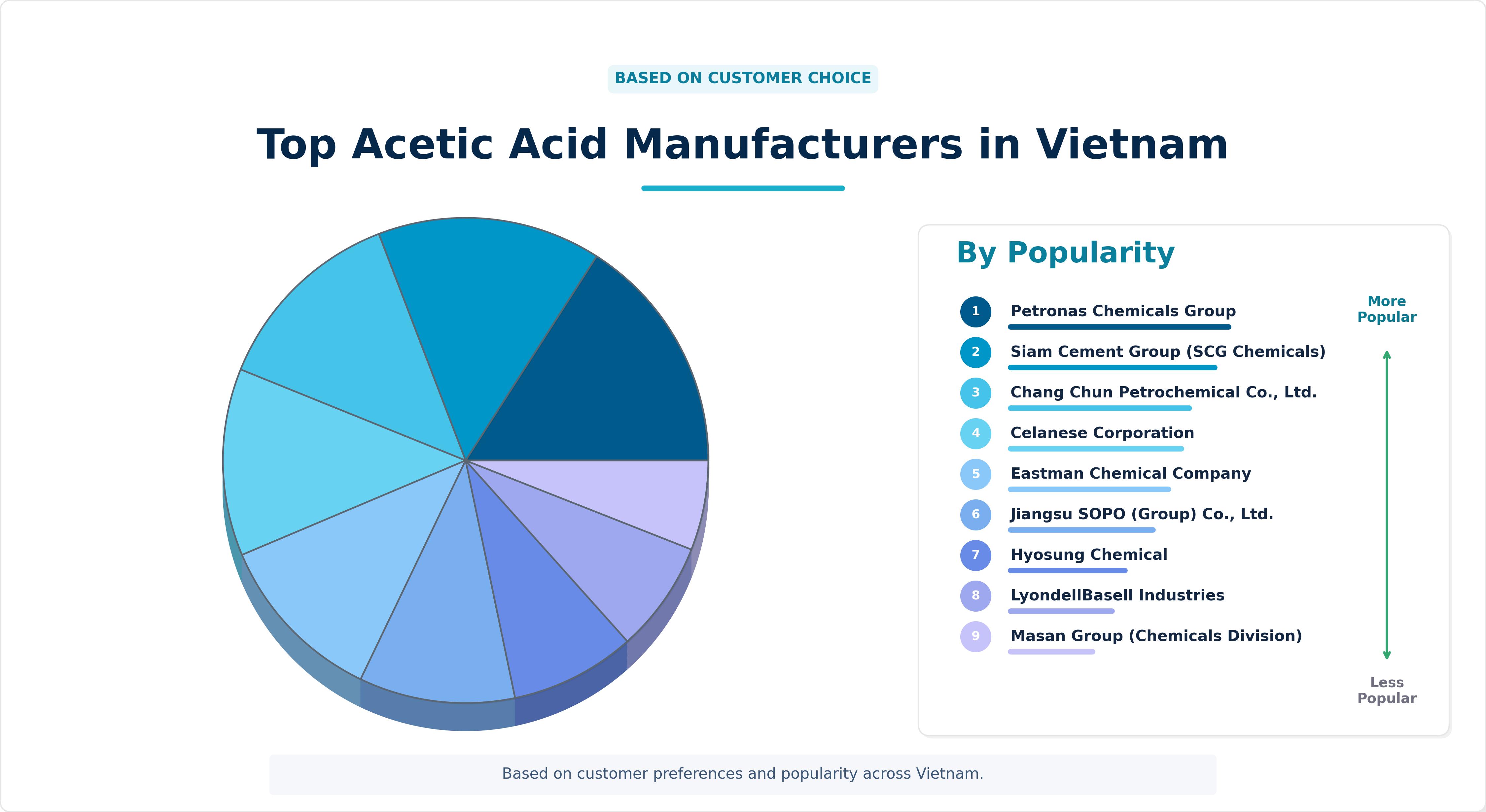
Best Acetic Acid Brands in Vietnam
The following table showcases a list of the best acetic acid brands, including:
| Company | Description | Strengths | Best for |
| Celanese Corporation | US-based global acetic acid & acetyl producer | Scale, integration, reliability | Bulk supply |
| Eastman Chemical Company | Specialty chemicals and advanced materials producer | Value-added derivatives, innovation | Specialty chemicals |
| Hyosung Chemical | Korean petrochemical and industrial chemicals firm | Cost efficiency, PET chain | Polymer production |
| Jiangsu SOPO (Group) Co., Ltd. | Chinese integrated chemical producer | Large-scale output, pricing | Commodity supply |
| LyondellBasell Industries | One of the world’s largest polymer & chemical firms | Feedstock access, scale | Industrial scale |
| Chang Chun Petrochemical Co., Ltd. | Taiwan-based petrochemical manufacturer | Stability, downstream integration | Resin production |
| Petronas Chemicals Group | Major ASEAN integrated chemical producer | Feedstock advantage, logistics | Regional supply |
| Siam Cement Group (SCG Chemicals) | Southeast Asian diversified chemicals leader | Regional reach, diversification | ASEAN markets |
| Masan Group (Chemicals Division) | Emerging Vietnam-based chemicals player | Cost base, growth focus | Emerging markets |
Why the Right Acetic Acid Partner is Key to Consistent Production?
Selecting the correct acetic acid supplier is more than simply a sourcing issue; it is a way of ensuring the stable production. Every sector may experience major disruptions to their production chain by small inconsistencies in either product purity or availability, in that condition a supplier works like the company’s own factory by ensuring a steady supply, consistent quality, and stable prices without interruptions.
Top Acetic Acid Manufacturers in Vietnam - Rated by Viewgates
Here are shown the ratings and official website of each company:
| Company | Rating | Official Website |
| Celanese Corporation | 4.8/5 | Visit Official Website (Celanese Corporation) |
| Eastman Chemical Company | 4.7/5 | Visit Official Website (Eastman Chemical Company) |
| Hyosung Chemical | 4.6/5 | Visit Official Website (Hyosung Chemical) |
| Jiangsu SOPO (Group) Co., Ltd. | 4.3/5 | Visit Official Website (Jiangsu SOPO (Group) Co., Ltd.) |
| LyondellBasell Industries | 4.8/5 | Visit Official Website (LyondellBasell Industries) |
| Chang Chun Petrochemical Co., Ltd. | 4.5/5 | Visit Official Website (Chang Chun Petrochemical Co., Ltd.) |
| Petronas Chemicals Group | 4.6/5 | Visit Official Website (Petronas Chemicals Group) |
| Siam Cement Group (SCG Chemicals) | 4.7/5 | Visit Official Website (Siam Cement Group) |
| Masan Group | 4.4/5 | Visit Official Website (Masan Group) |
How We Evaluate and Rate These Companies At Viewgates
Our evaluations are based on user feedback, service quality, pricing, feature analysis, and overall market presence. We follow a structured methodology to ensure fair and consistent comparisons. You can learn more about how we rate and review companies on our Review Guidelines page. Ratings may vary based on user preferences and real-world usage.
If you have any questions, feedback, or suggestions regarding our evaluations, feel free to contact us at support@viewgates.com. Our team will review your query and respond as quickly as possible during our official working hours.
Overview of the Acetic Acid Manufacturers and Market Trends
Here are some notable trends in the acetic acid market in Vietnam:
Material Trends: Vietnam’s acetic acid market is gradually shifting from conventional petrochemical-based inputs toward more sustainable and bio-based alternatives. Industries such as textiles, coatings, and packaging are increasingly exploring eco-friendly feedstocks due to tightening environmental expectations and export compliance requirements. However, imported petrochemical-grade acetic acid still dominates due to limited domestic production of bio-based variants, creating a dual-material structure in the market where both traditional and green materials coexist.
Demand Pattern: Demand for acetic acid in Vietnam is gradually increasing in Vietnam. Due to strong growth in industries such as textiles, plastics, adhesives, and pharmaceuticals, the demand for acetic acid is continuous to rise. Lastly, food processing and packaging sectors continue to contribute stable baseline demand.
Acetic Acid Pricing: The price of acetic acid ranges from $ 700 to $1500 in Vietnam. The cost of acetic acid gets affected due to major factors like dependence and global feedstock volatility impact the price of acetic acid, particularly methanol and carbon monoxide costs. Fluctuation in the raw-material price, foreign exchange rates, and the world petrochemical cycle have a direct influence on local prices.
Acetic Acid Types: Vietnam chemical industry is seeing growth in the use of glacial acetic acid, as well as other forms that include acetate esters, acetic anhydride, and vinyl acetate monomers. Bio-based acetic acid is gaining attention, although it remains a niche segment due to limited production infrastructure.
Trends in Sustainability: Government of each country has shifted their focus on sustainability factor, especially in industries. As a result, the bio-acetic acid has become trend with low-carbon chemical production. There is considerable promotion through government-driven projects and consumers' understanding of green chemicals in favour of renewable chemical pathways.
Industry Overview: The acetic acid industry in Vietnam is an import-led industry that is supported by well-developed downstream chemical and manufacturing industries. This industry has a vital role to play in manufacturing plastic materials, textile fibres, paint, adhesive, and food ingredients. Growth will be driven by increased manufacturing capacity and integration into the global market.
Where to Buy: Vietnamese buyers could source the acetic acid or any chemical product from various options. Those options are industrial chemical distributors, importers, and direct supplier contracts. A large quantity of this chemical is imported from regional chemical hubs in China, South Korea, and Southeast Asia. B2B chemical trading companies are also a reliable option.
Guide to Pick the Right Acetic Acid Brand
The below table will help in selecting the right manufacturers of acetic acid according to application and price level:
| Applications | Cost (Approx., /ton) | Brands |
| High-Purity Industrial Use | $1,000 – $1,650 | Eastman Chemical Company, Celanese Corporation |
| Regulated Industrial & Export Applications | $950 – $1,550 | Celanese Corporation, LyondellBasell Industries (Netherlands/USA), Petronas Chemicals Group |
| Bulk Industrial Supply | $800 – $1,250 | Jiangsu SOPO (Group) Co., Ltd. (China), Chang Chun Petrochemical Co., Ltd. |
| Cost-Sensitive Manufacturing | $700 – $1,050 | Jiangsu SOPO (Group) Co., Ltd. (China), Hyosung Chemical |
| Logistics & Supply Chain Dependent Use | $850 – $1,350 | Petronas Chemicals Group (Malaysia), Siam Cement Group (SCG Chemicals) |
| R&D, Pharma & Specialty Chemical Applications | $1,050 – $1,700 | Eastman Chemical Company, Celanese Corporation |