Top Camera Lens Brands in Japan - Why You Actually Need the Right One

The camera is one of the familiar products that are often used by each of us to capture special moments, especially in recent years. There is a huge impact of social media on people, due to which the demand for camera lenses has increased. The camera lens is regarded as one of the most important parts of a camera, as it focuses light onto the camera sensor, which captures images. The camera lens has a significant role in maintaining the quality, clarity, and brightness of images, which makes it an important factor for both professional and amateur users. Camera lenses are used in many different fields, but their use is prominent in photography, especially in Japan, where there is a growing need for better images. The use of an appropriate camera lens can significantly contribute to shaping the result of images and assist in capturing images precisely.
Which Are the Most Preferred Camera Lens Brands in Japan?
The chart below reflects ViewGates proprietary brand popularity ranking methodology, based on a combination of internal analysis, survey insights, consumer preference signals, search trends, digital visibility, publicly accessible industry data, and other comparative indicators. Rankings are independently evaluated and updated by the ViewGates Editorial & Research Team to deliver credible, research-backed insights.
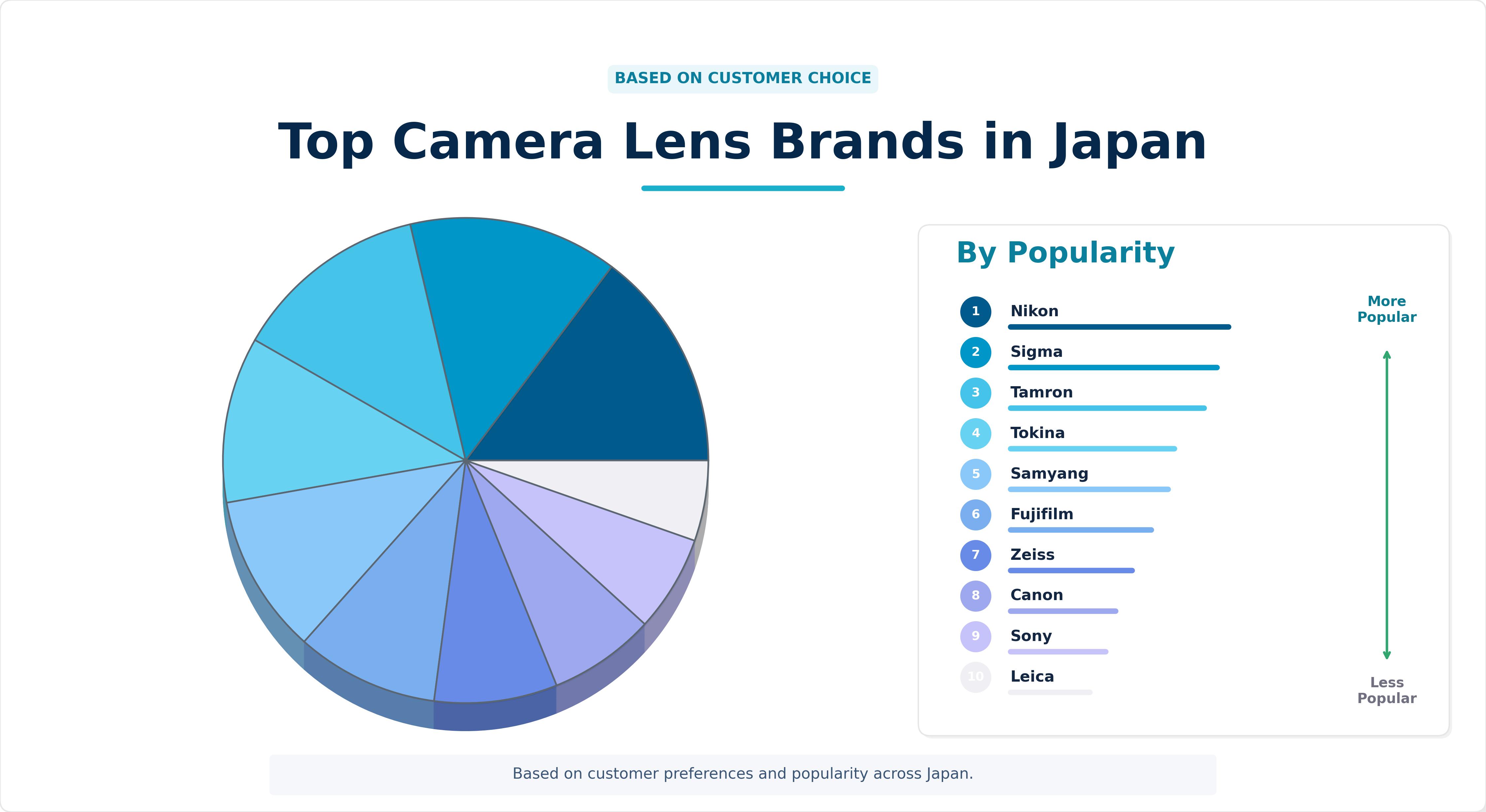
Top Camera Lens Brands in Japan
While purchasing a camera lens, it is necessary to consider the following major factors:
- Focal Length: Focal length is significant in maintaining the distance of objects from the camera lens.
- Aperture: The aperture is used to regulate the amount of light passing into the lens. Camera lenses with larger apertures, such as f/1.4, allow lighter to pass into the lens.
- Lens Mount: All brands have their own lens mounts; therefore, compatibility is crucial.
- Image Stabilization: This technology is used to enhance the appearance of blurry images, especially in low-light conditions.
Top Camera Lens Brands Available in Japan
Some of the best camera lens brands, the area of application, and the strengths of the brands are as follows:
| Brand | Best For | Strengths |
| Canon | All-round photography and video | Its camera lens is made with excellent optical quality, variety, and reliability for both amateur and professional use. |
| Nikon | Professional photography | Nikon is known for its professional camera lenses, which are reliable for precise performance. |
| Sony | Mirrorless camera systems | This brand offers fast autofocus, excellent image quality, and compact designs best for both enthusiasts and professionals. |
| Sigma | Professional and creative photography | Delivers productive lenses at competitive prices, making it an excellent choice for both professionals and creatives. |
| Tamron | Versatile lens options | Provides excellent image quality with features like stabilization and wide focal length options. |
| Zeiss | High-end, cinematic lenses | This is one of those companies that provide premium lenses, often used in cinematography. |
| Fujifilm | Mirrorless photography | They are expert in lenses for mirrorless cameras, with a reputation for sharpness, colour accuracy, and overall optical quality. |
| Leica | Luxury and professional photography | This brand provides the best camera lenses in the world with exceptional optical performance, craftsmanship, and precision. |
| Tokina | Wide-angle and macro lenses | Its camera lens has wide-angle and macro lenses with excellent image quality for landscape, nature, and close-up photography. |
| Samyang | Budget-friendly and manual lenses | They make manual-focus lenses that are affordable, with great optical performance, best for photographers with strict budgets. |
Customer Decision Factor Ratings of Top Camera Lens Brands in Japan
Key Considerations That Influence Consumer Choices While Making Purchase Decision:
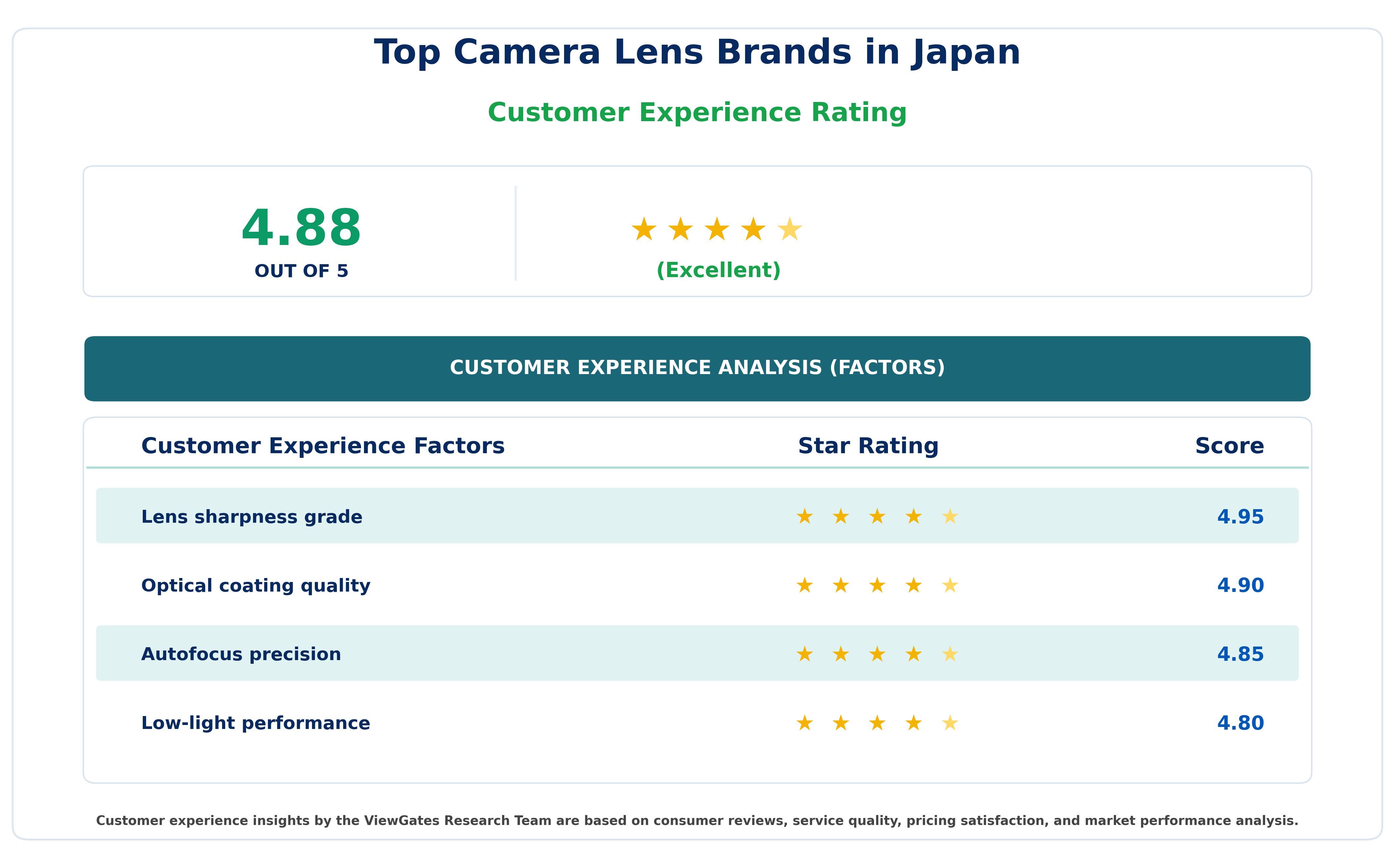
Top Camera Lens Brands in Japan - Rated & Reviewed by Viewgates
| Company Name | Rating (out of 5) |
| Canon | 4.8 / 5 |
| Nikon | 4.7 / 5 |
| Sony | 4.6 / 5 |
| Sigma | 4.5 / 5 |
| Tamron | 4.4 / 5 |
| Zeiss | 4.8 / 5 |
| Fujifilm | 4.7 / 5 |
| Leica | 4.6 / 5 |
| Tokina | 4.3 / 5 |
| Samyang | 4.5 / 5 |
Our evaluations are based on user feedback, service quality, pricing, feature analysis, and overall market presence. We follow a structured methodology to ensure fair and consistent comparisons. You can learn more about how we rate and review companies on our Review Guidelines page. Ratings may vary based on user preferences and real-world usage.
If you have any questions, feedback, or suggestions regarding our evaluations, feel free to contact us at support@viewgates.com. Our team will review your query and respond as quickly as possible during our official working hours.
How to Choose the Right Camera Lens for Your Needs in Japan
To choose the right camera lens entirely depends on your specific photography needs and objectives.
- Portrait Photography: Having a wide aperture in a camera lens would be appropriate for sharp subject isolation and soft background blur.
- Landscape Photography: It requires a wide-angle lens that should be sharp and have low distortion. Example – 16-35mm.
- Sports and Wildlife Photography: Sports and Wildlife Photography – It requires a lens that has a focal length of 70-200mm and is F2.8.
- Macro Photography: In this type of photography, a focused macro lens with high magnifying power is a must-have.
It is also necessary to ensure that the lens is compatible with the camera and has the necessary features to perform the photography to be done.