Top 10 Cement Manufacturers in Japan - Leading Manufacturers and Trusted Brands

Cement is an important building material that is used all over the country to build roads, bridges, and other infrastructure projects. When mixed with water, and aggregates to make concrete or mortar, it hardens over time and is mostly used as a binding agent. To make it, grind clinker is used, which is made by heating limestone, clay, and other minerals in a kiln. It comes in different types, each designed for specific applications, including Ordinary Portland Cement (OPC) for general use, Pozzolana Cement for enhanced durability, and special types like Rapid Hardening Cement, Sulphate Resisting Cement, and High-Strength Cement for more demanding construction needs.
Which Are the Most Preferred Cement Manufacturers in Japan?
The chart below reflects ViewGates proprietary brand popularity ranking methodology, based on a combination of internal analysis, survey insights, consumer preference signals, search trends, digital visibility, publicly accessible industry data, and other comparative indicators. Rankings are independently evaluated and updated by the ViewGates Editorial & Research Team to deliver credible, research-backed insights.
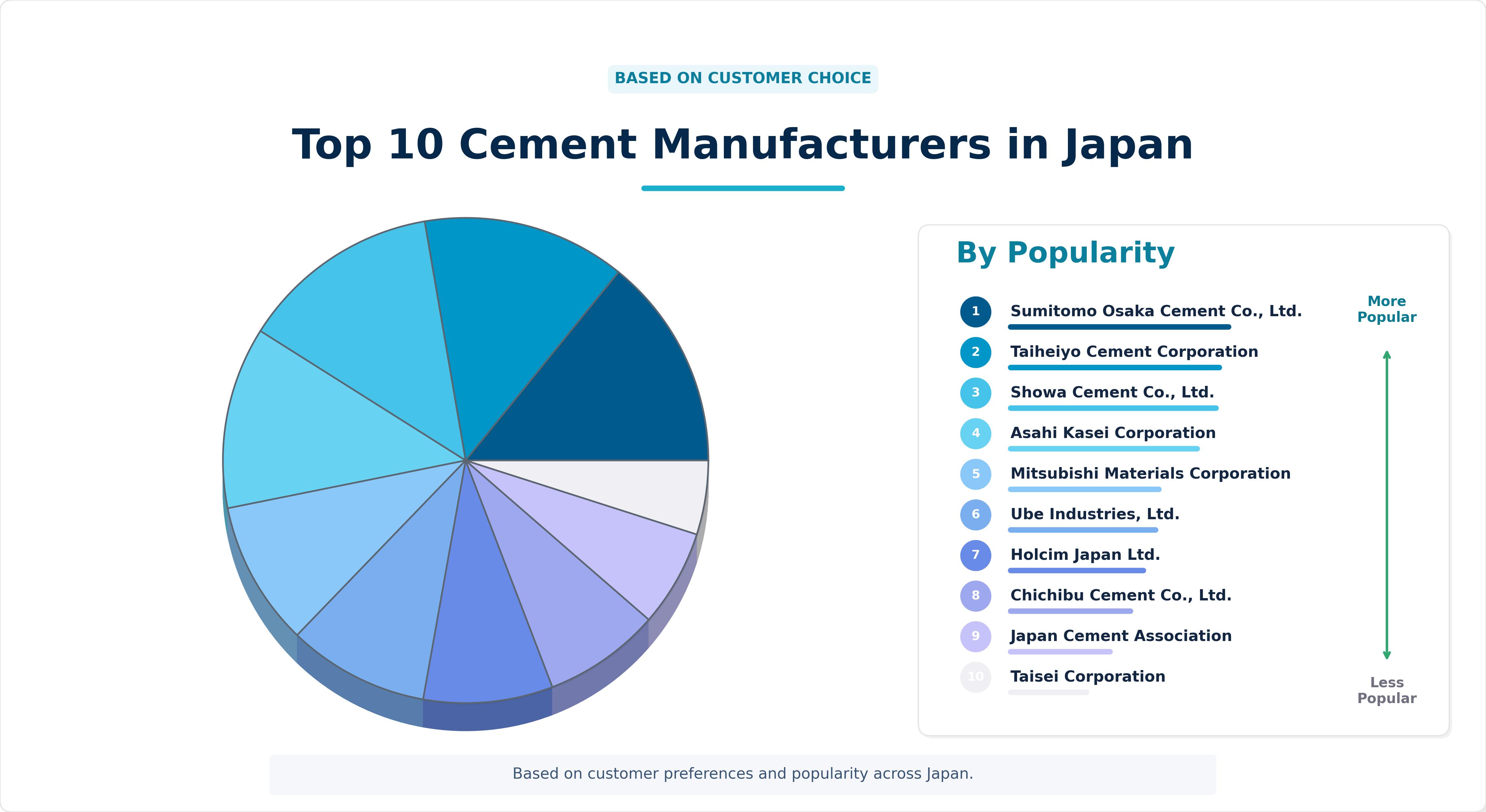
Best Brands in Japan Cement Industry
Here are few brands’ name with their strengths and areas of expertise:
| Brand | Best For | Strengths |
| Taiheiyo Cement Corporation | Cement production & distribution | This brand has broad research into low-carbon cement technologies. |
| Sumitomo Osaka Cement Co., Ltd. | Cement production & sales | This has expertise in the production of high-quality cement for infrastructure, especially in big construction projects. |
| Mitsubishi Materials Corporation | Cement & building materials | This is famous for innovation in construction materials and sustainability practices in cement production. |
| Holcim Japan Ltd. | Cement manufacturing | This is on top with environmental sustainability, integrating eco-friendly practices into cement production. |
| Asahi Kasei Corporation | Cement & building materials | This brand is integrating technology and environmentally responsible production methods in modern construction. |
| Japan Cement Association | Cement industry promotion | This promotes collaboration within the industry and support sustainable practices and contribute to policy-making decisions. |
| Ube Industries, Ltd. | Cement manufacturing | This company is providing advanced production techniques and commitment to energy-efficient cement manufacturing processes. |
| Taisei Corporation | Cement for construction & engineering | This offers high-quality cement for engineering projects and has a strong presence in both residential and construction sectors. |
| Chichibu Cement Co., Ltd. | Cement production & distribution | Mainly, this is focused on the production of high-quality cement. |
| Showa Cement Co., Ltd. | Cement manufacturing & research | This provides innovation, especially in producing eco-friendly and low-carbon footprint cement products. |
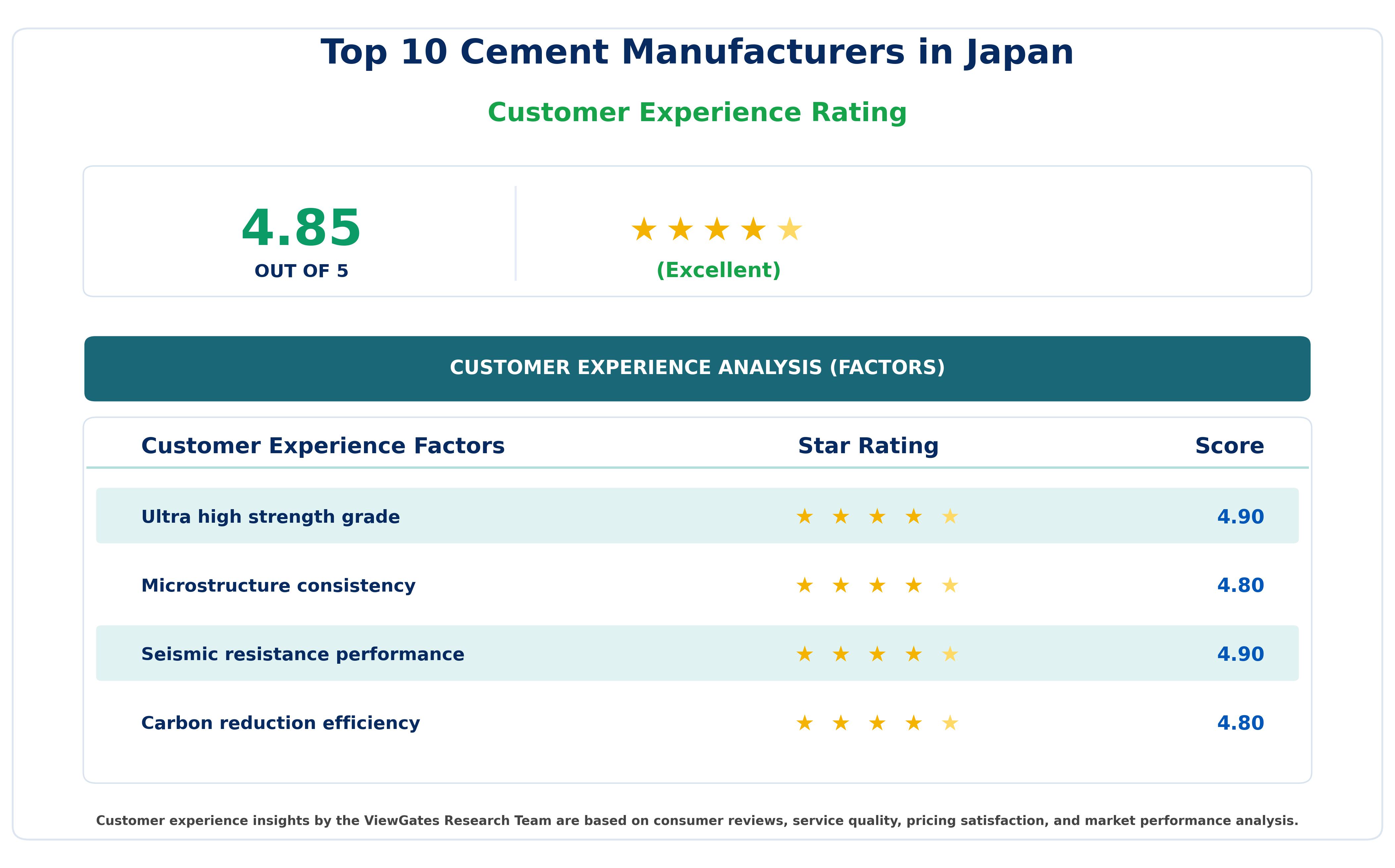
Customer Decision Factor Ratings of Top 10 Cement Manufacturers in Japan
Key Considerations That Influence Consumer Choices While Making Purchase Decisions:
Why is Choosing the Right Cement Manufacturer Important?
In Japan, selecting the right cement manufacturer is important for making sure for the safety, durability, and sustainability of construction projects. Cement is a key component in building earthquake-resistant infrastructure, therefore, reliable manufacturers is important as they give guarantees to high-quality products that meet strict guidelines. They also help prevent problems like structural failure or the use of inferior materials, which can compromise safety and longevity. Lastly, making the right choice of manufacturer is important for successful project execution, especially in a country like Japan, where high standards are vital for public safety and infrastructure quality.
Most Common Uses of Cement in Japan
Here is the list of common usages and variety of applications:
| Product Category | Ideal Usage |
| Ordinary Portland Cement | This is used in general construction, from residential buildings to infrastructure projects. |
| Ready-Mix Concrete | These pre-mixed cements are demanding in large construction projects. |
| Blended Cement | This provides higher resistance to environmental conditions. |
| White Cement | This is perfect for enhancing wall and aesthetic construction applications. |
| Hydraulic Cement | This is ideal for underwater or damp environment construction, offering strong durability. |
| Sustainable Cement Solutions | Focused on ecofriendly-conscious construction projects. |
| Cement Mortars and Plasters | This is applied in residential and commercial buildings to finish surfaces and wall treatments. |
| Precast Concrete Products | Factories demand this product for on-site for constructing precast walls and floors. |
Key Cement Trends: How Consumers are Ensuring Efficient Construction:
- Rising Preference for Sustainable and Eco-Friendly Products: Consumers are choosing cement products that are better for the environment, like low-carbon or blended cements.
- A Rise in the Demand for High-Performance and Durable Materials: Consumers who work in construction and development seek cement that is stronger, lasts longer, and is more durable.
- Increasing Focus on Cost-Effectiveness: As the cost of materials goes up, customers are looking for cement products that offer better value for money. This includes choosing cement products that are more efficient, which means they produce less waste, cost less to transport and use less energy to make.
- Preference for Localized Sourcing: Consumers are shifting toward cement suppliers who have factories nearby as this cuts down on delivery times and the carbon footprints that come with transportation.
- Growing Demand for Customization: Consumers are becoming more selective about what they buy, and are asking for cement products that meet their specific needs. This includes cements that are made for high-performance uses such as marine construction or harsh weather.
An In-Depth Comparison of Cement Solutions in Japan
Here is a table showcase the comparison of different types of cement solutions based on their features and costs:
| Features | Basic Cement Solutions | Mid-Range Cement Solutions | Advanced Cement Solutions |
| Level of Usage | Small to medium construction projects | Medium-scale infrastructure projects | Large-scale construction and public works |
| Technology Integration | Traditional cement production methods | Semi-automated production techniques | Advanced technologies with smart cement solutions and sustainability integration |
| Durability & Performance | Standard durability for residential buildings | Enhanced durability for commercial and industrial use | High-performance for infrastructure and eco-friendly projects |
| Average Cost | $500,000 to $2 million | $2 million to $10 million | $10 million and above |
| Ideal Users | Small construction firms & residential projects | Large contractors & infrastructure developers | Multinational companies & large public works contractors |
How We Evaluate and Rate These Companies At Viewgates
Our evaluations are based on user feedback, service quality, pricing, feature analysis, and overall market presence. We follow a structured methodology to ensure fair and consistent comparisons. You can learn more about how we rate and review companies on our Review Guidelines page. Ratings may vary based on user preferences and real-world usage.
If you have any questions, feedback, or suggestions regarding our evaluations, feel free to contact us at support@viewgates.com. Our team will review your query and respond as quickly as possible during our official working hours.
Below is the list of ratings and performance of top companies: A comprehensive rating and performance breakdown
Taiheiyo Cement Corporation
Based on Analysis & Market Data
Sumitomo Osaka Cement Co., Ltd.
Based on Analysis & Market Data
Tokuyama Corporation
Based on Analysis & Market Data
Aso Cement Co., Ltd.
Based on Analysis & Market Data
Nippon Steel Cement Co., Ltd.
Based on Analysis & Market Data
Hitachi Cement Co.,Ltd.
Based on Analysis & Market Data
Tsuruga Cement Co., Ltd.
Based on Analysis & Market Data
Ryukyu Cement Co., Ltd.
Based on Analysis & Market Data
Myojo Cement Co., Ltd.
Based on Analysis & Market Data