Top 9 Energy Storage Companies in India - Innovating Power Storage for a Greener India

Table of Contents
India’s energy future is being built on one critical foundation – the ability to store power efficiently and release it when it is needed most. Energy storage is no longer a back-end technical requirement but it is becoming central to how homes, industries and power grids function reliably. From large-scale battery systems supporting solar and wind farms to compact units backing up factory operations, the applications are wide and growing. The role of top energy storage companies in India is exceptional in this industry. Companies, such as Tata Power Renewable Energy, Adani Green Energy, are driving this space forward with serious investment and expanding product portfolios.
Which Are the Most Preferred Energy Storage Companies in India?
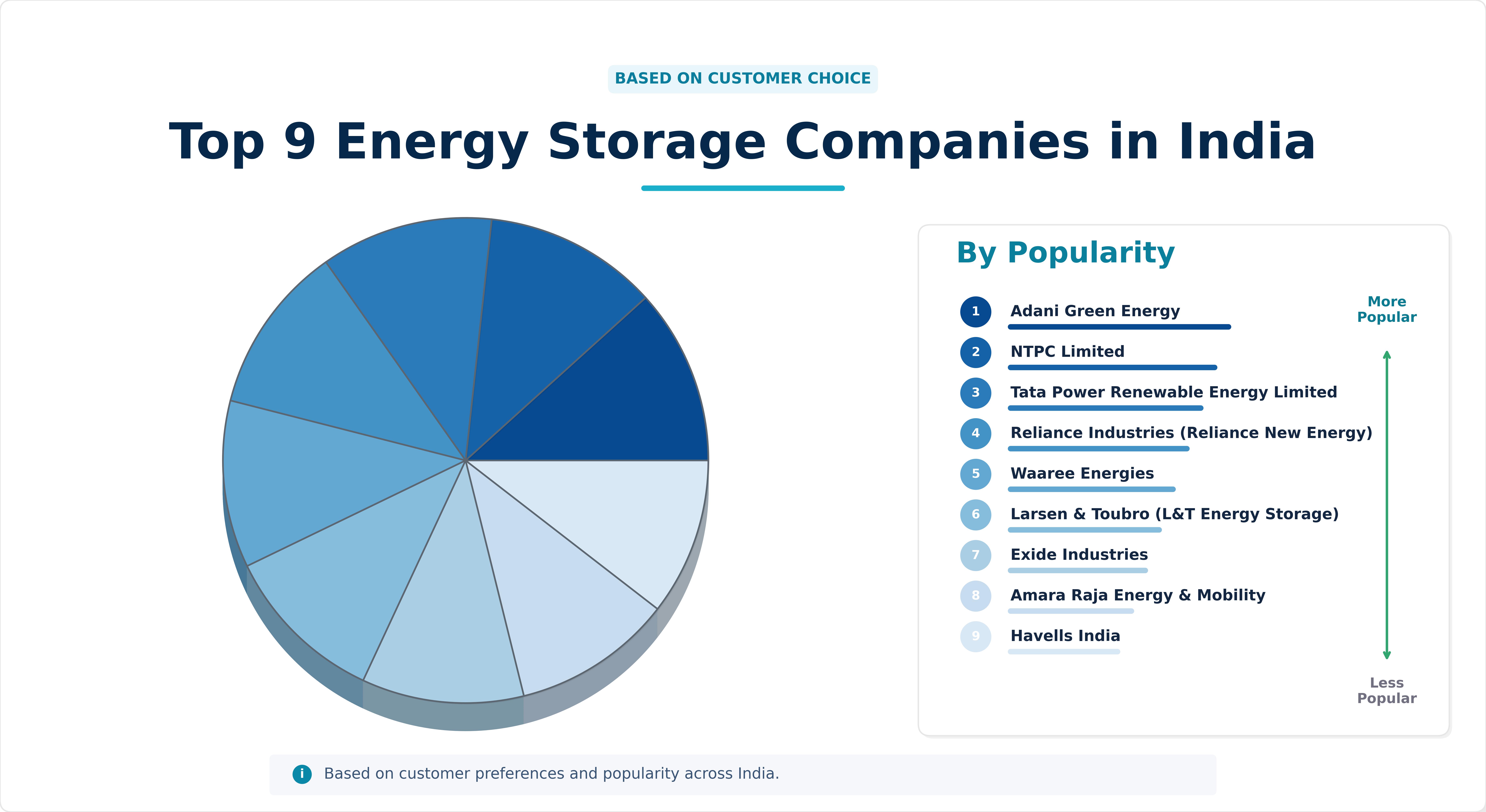
The chart below reflects ViewGates proprietary brand popularity ranking methodology, based on a combination of internal analysis, survey insights, consumer preference signals, search trends, digital visibility, publicly accessible industry data, and other comparative indicators. Rankings are independently evaluated and updated by the ViewGates Editorial & Research Team to deliver credible, research-backed insights.
Comparing the Top 9 Energy Storage Companies in India
These ratings reflect ViewGates independent expert evaluation across weighted factors (service quality, support, market presence). They are not user-submitted scores.
| Company | Best For | Pricing | ViewGate Score | Sub-scores (Quality · Support · Presence) |
| Adani Green Energy | Large-scale utility renewable projects | Enterprise | 4.80 / 5 | 4.8 · 4.6 · 5.0 |
| NTPC Limited | Government-led power and renewable projects | Enterprise | 4.75 / 5 | 4.6 · 4.7 · 5.0 |
| Tata Power Renewable Energy Limited | Integrated clean energy solutions for enterprises | Enterprise | 4.71 / 5 | 4.8 · 4.7 · 4.6 |
| Reliance Industries (Reliance New Energy) | Future-focused green energy ecosystem development | Enterprise | 4.62 / 5 | 4.5 · 4.5 · 4.9 |
| Waaree Energies | Solar module manufacturing and EPC solutions | Enterprise | 4.57 / 5 | 4.6 · 4.4 · 4.7 |
| Larsen & Toubro (L&T Energy Storage) | Engineering-led energy storage infrastructure projects | Enterprise | 4.47 / 5 | 4.5 · 4.4 · 4.5 |
| Exide Industries | Battery manufacturing and energy storage solutions | Mid-range | 4.43 / 5 | 4.4 · 4.3 · 4.6 |
| Amara Raja Energy & Mobility | Automotive batteries and emerging EV energy solutions | Mid-range | 4.37 / 5 | 4.4 · 4.2 · 4.5 |
| Havells India | Electrical equipment and distributed energy solutions | Mid-range | 4.36 / 5 | 4.3 · 4.3 · 4.5 |
Detailed Profile of the Top 9 Energy Storage Companies in India
Here are the full details of the top 9 energy storage companies in India:
1. Adani Green Energy
| Company Name | Adani Green Energy |
|---|---|
| Established Year | 2015 |
| Headquarters | Ahmedabad, India |
| Official Website | Click Here |
Adani Green Energy is a renewable power generation company focused on utility-scale solar, wind, and hybrid energy projects. It develops, owns, and operates large renewable energy assets across India, supplying electricity primarily through long-term power purchase agreements with central and state utilities. The company benefits from integrated execution capabilities within the Adani Group ecosystem, including project development and infrastructure support. Its core strength lies in rapid capacity addition and large project pipelines. Customers include government utilities and large commercial and industrial energy buyers.
2. NTPC Limited
| Company Name | NTPC Limited |
|---|---|
| Established Year | 1975 |
| Headquarters | New Delhi, India |
| Official Website | Click Here |
NTPC Limited is India’s largest integrated power utility engaged in electricity generation through coal, gas, hydro, and renewable energy sources. It also provides consultancy, project management, and power trading services. The company operates a vast portfolio of power plants and is expanding its renewable energy capacity as part of its energy transition strategy. NTPC serves state electricity boards, distribution companies, and industrial consumers across India, with select international consultancy and joint venture projects in neighbouring countries. Its strengths include scale, operational reliability, and strong integration with India’s power infrastructure.
3. Tata Power Renewable Energy Limited
| Company Name | Tata Power Renewable Energy Limited |
|---|---|
| Established Year | 2007 |
| Headquarters | Mumbai, India |
| Official Website | Click Here |
Tata Power Renewable Energy Limited is a subsidiary of Tata Power focused on renewable energy development, including solar, wind, hybrid systems, rooftop solar, and energy storage solutions. It undertakes engineering, procurement, and construction (EPC) as well as independent power producer (IPP) projects. The company serves utilities, commercial and industrial customers, and institutional clients. It is a key participant in India’s clean energy transition, supported by the broader Tata Group ecosystem. Its strengths include execution capability, diversified renewable portfolio, and strong corporate relationships across sectors.
4. Reliance Industries (Reliance New Energy)
| Company Name | Reliance Industries (Reliance New Energy) |
|---|---|
| Established Year | 2021 |
| Headquarters | Mumbai, India |
| Official Website | Click Here |
Reliance Industries is a diversified conglomerate with operations spanning energy, petrochemicals, retail, and digital services. Its New Energy business focuses on building an integrated clean energy ecosystem, including solar manufacturing, energy storage (batteries), green hydrogen, and renewable power generation. The initiative is designed to support large-scale decarbonization and domestic manufacturing of clean energy technologies. The company serves industrial, commercial, and infrastructure sectors, with ambitions for global supply chain integration in clean energy technologies. Its strengths include scale, capital investment capacity, and vertical integration across energy value chains.
5. Waaree Energies
| Company Name | Waaree Energies |
|---|---|
| Established Year | 1990 |
| Headquarters | Mumbai, India |
| Official Website | Click Here |
Waaree Energies is a solar energy company primarily engaged in the manufacturing of photovoltaic modules and provision of EPC services for solar projects. It also offers solar project development and O&M services for utility-scale and rooftop installations. The company supplies modules to domestic and export markets, serving utilities, industrial clients, and commercial users. Its strengths include large manufacturing capacity, integrated solar solutions, and established export channels. Waaree plays a significant role in India’s solar manufacturing ecosystem and participates in global solar supply chains.
6. Larsen & Toubro (L&T Energy Storage)
| Company Name | Larsen & Toubro (L&T Energy Storage) |
|---|---|
| Established Year | 1938 |
| Headquarters | Mumbai, India |
| Official Website | Click Here |
Larsen & Toubro is a major engineering, procurement, and construction (EPC) conglomerate with diversified operations across infrastructure, energy, and industrial projects. Its energy storage initiatives focus on battery energy storage systems (BESS), grid integration, and renewable power infrastructure as part of its broader energy transition portfolio. The company serves utilities, industrial clients, and government infrastructure programs. Its strengths include engineering expertise, large-scale project execution capability, and global EPC presence across multiple sectors.
7. Exide Industries
| Company Name | Exide Industries |
|---|---|
| Established Year | 1947 |
| Headquarters | Kolkata, India |
| Official Website | Click Here |
Exide Industries is a leading manufacturer of storage batteries, primarily serving automotive, industrial, and power backup applications. The company produces lead-acid batteries and is expanding into lithium-ion battery technologies for electric mobility and energy storage. It supplies original equipment manufacturers (OEMs), industrial users, and aftermarket customers. Its strengths include strong distribution networks, established brand presence in battery systems, and long-standing relationships with automotive manufacturers. Exide is actively transitioning toward advanced energy storage solutions aligned with electric mobility trends.
8. Amara Raja Energy & Mobility
| Company Name | Amara Raja Energy & Mobility |
|---|---|
| Established Year | 1985 |
| Headquarters | Tirupati, India |
| Official Website | Click Here |
Amara Raja Energy & Mobility is engaged in manufacturing batteries and developing energy storage and mobility solutions. Formerly known as Amara Raja Batteries, the company has expanded its focus toward lithium-ion technologies, energy storage systems, and electric mobility solutions. It serves automotive OEMs, telecom, industrial, and energy storage customers. Its strengths include strong OEM partnerships, manufacturing capabilities, and a growing focus on next-generation battery technologies aligned with energy transition and electrification trends.
9. Havells India
| Company Name | Havells India |
|---|---|
| Established Year | 1958 |
| Headquarters | Noida, India |
| Official Website | Click Here |
Havells India is a diversified electrical equipment manufacturer offering a wide range of products including cables, switches, fans, lighting, switchgear, and home appliances. The company serves residential, commercial, and industrial segments through a strong distribution and retail network. It also exports to multiple international markets. Its strengths include brand recognition in electrical goods, extensive product portfolio, and strong distribution reach across urban and rural markets. Havells operates across consumer electrical and infrastructure electrical segments.
Key Evaluation Factors We Assess
Some of the major factors that are used to review the energy storage companies in India:
| Evaluation Factor | What We Assess |
| Product & System Performance | Battery efficiency, storage capacity, lifecycle, and energy output stability |
| Technical Expertise & Compliance | Engineering capability, safety standards, certifications, and regulatory compliance |
| System Reliability & Maintenance | Uptime performance, durability, and ease of maintenance and service support |
| Cost Effectiveness & Value | Installation cost, energy savings, ROI, and long-term operational value |
Why Selecting the Right Energy Storage Provider Is Important for Industries
For any industry running on energy whether solar-powered factories, hospitals with critical backup needs, or telecom towers in remote areas. The energy storage provider you choose determines how reliably your operations actually run. A system that underperforms during peak demand or fails during a grid outage does not just create inconvenience; it causes production losses, equipment damage, and in sensitive environments, serious safety risks. Many industrial buyers have learnt this the hard way by choosing cheaper, uncertified battery systems that degraded within two years instead of the promised ten. The right energy storage partner brings certified technology, honest performance data, warranty-backed reliability, and technical support that stays with you across the system's full life.
Energy Storage Trends in India: Things You Should Know
Some of the major trends in the energy storage industry are:
Technology and Material Insights
Currently, lithium-ion batteries manufacturers in leading technologies in the energy storage market, driven by high energy density and declining manufacturing costs. Lithium-ion battery manufacturers in India are also looking at alternatives like sodium-ion and solid-state batteries that can provide better safety and longer cycle life. India’s local manufacturers are also trying to reduce their dependence on imported battery cells by developing local cell manufacturing capabilities.
Demand Patterns
Demand is coming heavily from sectors, such as renewable energy developers require storage solutions to mitigate intermittent solar and wind energy generation; industries need dependable backup power as grid stability remains an issue in many parts of India. The telecom industry has been an early and steady purchaser of battery storage systems throughout India. As electric vehicle adoption grows, second-life battery systems — repurposed EV batteries used for stationary storage — are emerging as a cost-effective demand segment.
Pricing Overview
Energy storage system pricing depends heavily on capacity, chemistry, and application type. Large-scale lithium-ion installations for industrial or grid use are priced differently from smaller commercial or residential backup systems. Costs have been falling steadily as manufacturing scales up, and government incentives under production-linked schemes are helping bring prices down further for domestically manufactured systems.
Types of Energy Storage Solutions
The market covers a wide range — from lead-acid and lithium-ion battery systems to flow batteries designed for longer discharge durations. Utility-scale storage projects, like those developed by Adani Green Energy and NTPC, operate very differently from the industrial UPS systems sold by Exide Industries or Amara Raja. Buyers need to match the storage type to their specific use case — a hospital backup requirement and a solar farm storage need are fundamentally different problems.
Sustainability Trends
Energy storage is itself a sustainability tool, enabling greater use of renewable power by solving the intermittency problem that limits solar and wind reliability. Companies like Waaree Energies and Reliance New Energy are integrating storage directly with renewable generation to offer cleaner, uninterrupted power solutions. Battery recycling and responsible disposal are also gaining attention, with manufacturers beginning to build take-back and recycling programmes to handle end-of-life systems responsibly.
Market Overview
India’s energy storage industry is still in the beginning stage but growing fast with the private companies and government supported entities such as NTPC making a significant investment. Policy support such as viability gap funding for battery storage projects and PLI schemes for advanced cell manufacturing are giving the industry a solid structural push. Competition is increasing as new players are entering the market and this will improve product quality and introduce more transparency in pricing for buyers.
Where to Source
In India, large industries and utility buyers typically engage go to major engineering service companies like Tata Power, L&T Energy Storage, or NTPC for customised, project-scale installations with long-term service agreements. Smaller commercial buyers, like factories, hospitals, commercial buildings — usually work through authorised dealers or system integrators that combine equipment supply with installation and commissioning.
How ViewGates evaluates and rates these companies
Our evaluations are conducted independently by the ViewGates Editorial & Research Team. To build a complete picture of each company, our analysts aggregate public sentiment and data from multiple external sources — including community and trade forums, survey data, verified reviews across the web, and direct industry inquiries — and combine this with our internal database and proprietary scoring criteria such as service quality, support, pricing, and overall market presence.
User sentiment is one input among many; final ratings reflect ViewGates' independent expert assessment and are not based on direct user submissions on this platform. We follow a structured, consistent methodology to ensure fair comparisons across companies. Learn more on our Methodology page. To suggest a correction, contact us at support@viewgates.com.