Top Joint Replacement Brands in Japan - Recognized Names and Leading Orthopedic Brands

Joint replacement is a surgery where a damaged or worn-out joint is removed and replaced with an artificial one that is made of metal, plastic, or ceramic materials. This artificial joint is especially designed to move just like a natural joint. The most common joints replaced are generally the knee and hip, but shoulder, elbow, and ankle joints can also be replaced.
Which Are the Most Preferred Joint Replacement Brands in Japan?
The chart below reflects ViewGates proprietary brand popularity ranking methodology, based on a combination of internal analysis, survey insights, consumer preference signals, search trends, digital visibility, publicly accessible industry data, and other comparative indicators. Rankings are independently evaluated and updated by the ViewGates Editorial & Research Team to deliver credible, research-backed insights.
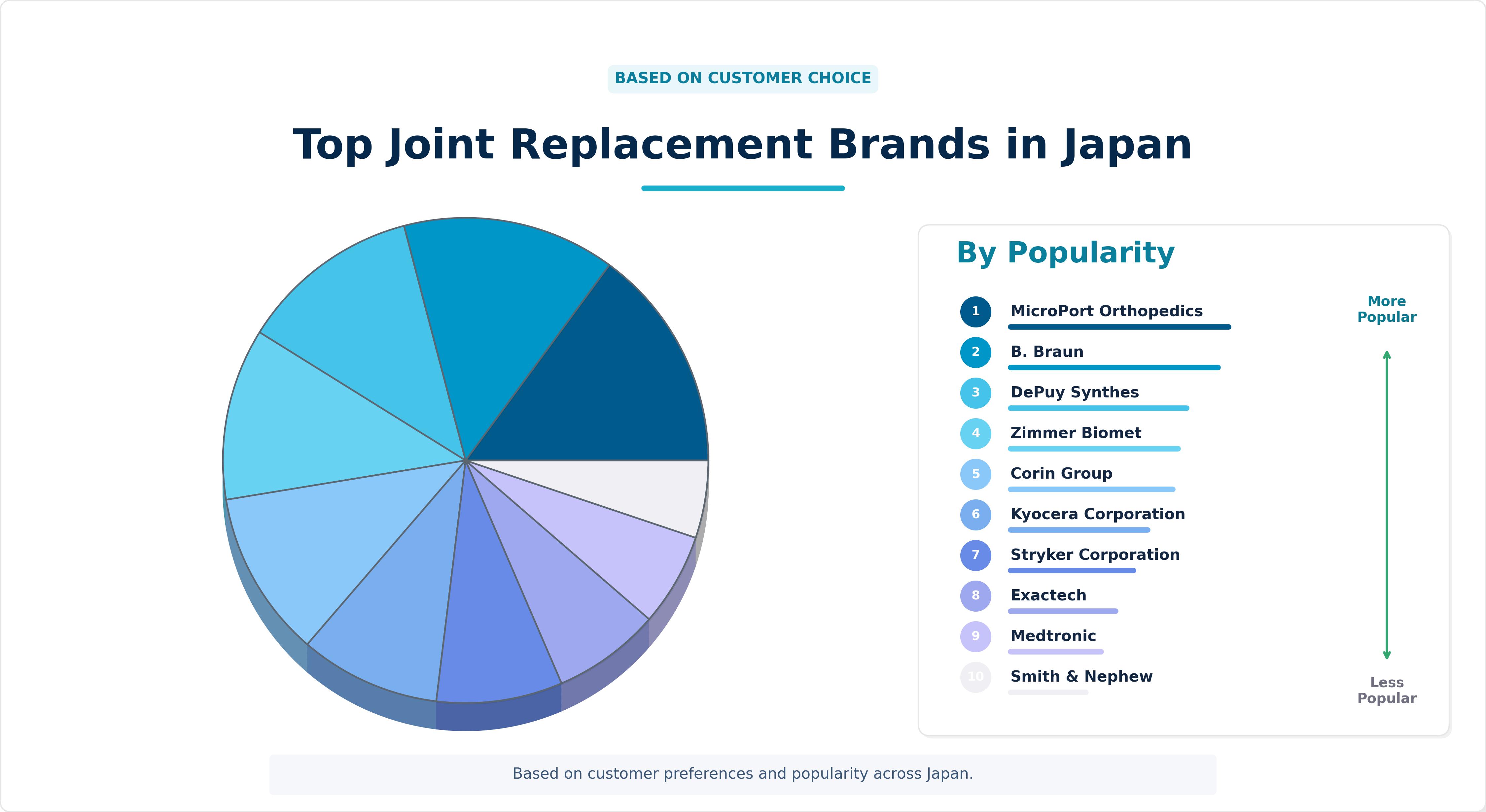
Best Brands in Japan Joint Replacement Industry
Here is the list of top brands with their specialization, and major strengths:
| Brand | Best For | Strengths |
| Zimmer Biomet | Knee & hip implants | This offers strong implant designs with proven long-term clinical results and strong surgeon training programs. |
| Stryker Corporation | Robotic-assisted joint replacement | This is known for advanced robotic platforms that is enhancing the surgical accuracy and patient outcomes. |
| DePuy Synthes | Total joint reconstruction | It provides the exclusive portfolio of hip and knee systems with strong clinical evidence. |
| Smith & Nephew | Minimally invasive solutions | This majorly focuses on tissue-sparing implants and faster post-operative recovery pathways. |
| Kyocera Corporation | Ceramic joint implants | This is specialized in ceramic-based implants with high wear resistance and biocompatibility. |
| Medtronic | Orthopedic surgical technologies | Medtronic does implantation with navigation and surgical planning technologies. |
| Exactech | Knee replacement systems | This delivers patient-specific knee solutions maintained by data-driven implant design. |
| Corin Group | Hip replacement implants | This emphasizes the personalized implant positioning and biomechanical alignment. |
| MicroPort Orthopedics | Cost-efficient implants | It supplies trusted reliable implant solutions suited for value-focused healthcare systems. |
| B. Braun | Surgical instruments & implants | This is known for precision surgical tools and high-quality implant materials. |
Customer Decision Factor Ratings of Top Joint Replacement Brands in Japan
Key Considerations That Influence Consumer Choices While Making Purchase Decisions: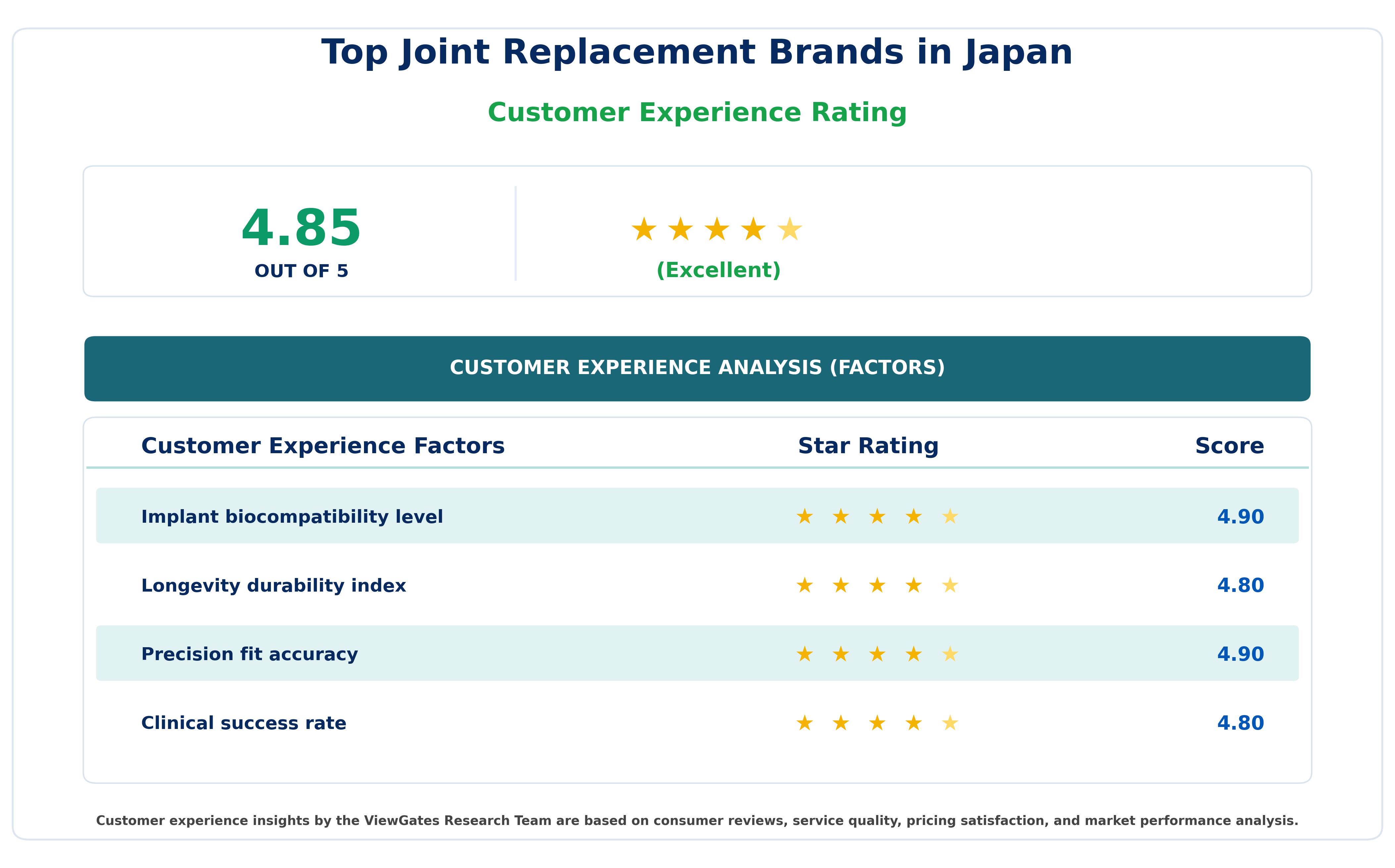
Why is Joint Replacement Needed?
People generally consider joint replacement serious when pain becomes constant and affects daily life. If medications, physical therapy, or lifestyle changes no longer provide relief, surgery may be the best & considered the last option for a person. It really helps improve mobility, reduce stiffness, and improve the overall quality of life in the long run.
Most Common Uses of Joint Replacement in Japan
Here are major product categories and with their common usages:
| Product Category | Ideal Usage |
| Knee Replacement Implants | Widely used for advanced osteoarthritis and age-related knee degeneration. |
| Hip Replacement Implants | Cases like hip fractures, arthritis, and reduced joint mobility, are treated by this procedure. |
| Partial Joint Replacement | This is especially for the patients with damage limited to specific joint areas. |
| Revision Joint Implants | This is used when existing implants require replacement or correction. |
| Shoulder Replacement Systems | This helps to restore the shoulder’s movement and reduce long-term joint pain. |
| Surgical Navigation Systems | This improves the implant placement accuracy during procedures. |
| Robotic-Assisted Surgery Systems | This supports the precise alignment and consistency in complex surgeries. |
| Orthopedic Bone Cement | It ensures the strong fixation between implant and bone. |
| Post-Surgical Rehabilitation Devices | This procedure helps to recover and supports long-term joint function improvement. |
Latest Trends in Joint Replacement in Japan
Joint replacement surgery has come a long way. Here is what is new and happening today:
- Smaller Cuts, Faster Healing: Surgeons today make much smaller cuts during surgery compared to before. This means less blood loss, less scarring and patients go home sooner.
- Same-Day or Next-Day Discharge: Earlier, patients had to stay in the hospital for many days. Now, many patients can go home the same day or the very next day after surgery.
- Longer Lasting Joints: The artificial joints being used today are made of better materials. They last much longer, up to 20 to 30 years, so younger patients can also benefit from this surgery.
- Personalized Joints: Doctors can now create artificial joints that are custom-made to fit the exact shape and size of a patient's body, just like a tailor-made outfit. This gives better results and more comfort.
An In-Depth Comparison of Joint Replacement Solutions
This table compares different joint replacement solutions based on technology, recovery, and cost:
| Features | Basic Joint Replacement Solutions | Mid-Range Joint Replacement Solutions | Advanced Joint Replacement Solutions |
| Level of Usage | Used in general hospitals | Common in private and specialized hospitals | Predominant in advanced orthopedic centres |
| Technology Addition | Conventional surgical instruments | Computer-assisted navigation systems | Robotic and AI-supported platforms |
| Patient Recovery | Longer rehabilitation period | Balanced recovery timeline | Faster recovery with minimally invasive approaches |
| Cost | USD 6,000 – USD 10,000 | USD 10,000 – USD 18,000 | USD 18,000 and above |
| Ideal Users | Domestic patients under standard care | Patients seeking enhanced precision | Complex cases and high-end medical services |
How We Evaluate and Rate These Companies At Viewgates?
Our evaluations are based on user feedback, service quality, pricing, feature analysis, and overall market presence. We follow a structured methodology to ensure fair and consistent comparisons. You can learn more about how we rate and review companies on our Review Guidelines page. Ratings may vary based on user preferences and real-world usage.
If you have any questions, feedback, or suggestions regarding our evaluations, feel free to contact us at support@viewgates.com. Our team will review your query and respond as quickly as possible during our official working hours.
Below is the list of ratings and performance of top companies: A comprehensive rating and performance breakdown
Zimmer Biomet
Based on Analysis & Market Data
Stryker Corporation
Based on Analysis & Market Data
DePuy Synthes
Based on Analysis & Market Data
Smith & Nephew
Based on Analysis & Market Data
Kyocera Medical Technologies
Based on Analysis & Market Data
Nakashima Medical
Based on Analysis & Market Data
Japan Medical Dynamic Marketing, Inc.
Based on Analysis & Market Data
Enovis
Based on Analysis & Market Data
Aesculap
Based on Analysis & Market Data
Mizuho Medical
Based on Analysis & Market Data